


Corrosion test coating scratch pen scratch tester
Other Products


Product Name: Corrosion Test Coating Scratch PenScratch Tester
Model Number:426Type
Instrument Introduction:
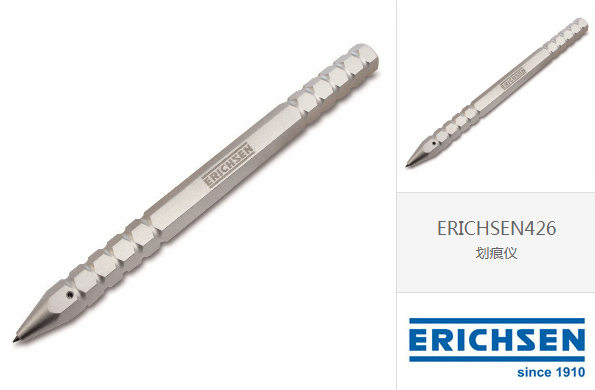
ERICHESEN Germany 426 Scratch Pen. The method of scratching a St. Andrew's cross on test panels is well-known for preparing short-term and wear-resistant corrosion test samples, thereby examining the protective effect of coatings against substrate corrosion. The Model 426 Scratch Pen is a portable and versatile tool: used to create incisions on coated surfaces in preparation for corrosion tests, such as salt spray, continuous or intermittent immersion, accelerated aging, gas corrosion, and humidity tests.
Purpose and Application
The method of scratching a St. Andrew's cross on test panels is well-known for preparing short-term and wear-resistant corrosion test samples, thereby examining the protective effect of coatings against substrate corrosion.
The Model 426 Scratch Pen is a portable and versatile tool: used to create precise incisions on coated surfaces in preparation for corrosion tests, such as salt spray, continuous or intermittent immersion, accelerated aging, gas corrosion, and humidity tests.
Instrument Design
A spherical tungsten scratch needle with a diameter of φ0.5mm (f0.020") is firmly mounted on an alumina pen-shaped handle. The ergonomic design ensures stability during scratching operations.
The spherical test point has undergone the following durability test:
A circular steel surface with a diameter of f100mm (f4") clamped on a lathe was scratched by the needle at a speed of 20cm/s and a pressure of 50 N (11 lbs). After running for 18000cm (600ft), the spherical test point showed no damage.
This means it can make 2000 scratches of 90 mm (31/2") in length without damage.

Test Principle
Used to create specific scratches on protective coating surfaces. At the start of corrosion tests and at regular intervals, the test needle is used to scratch the test panel. These scratches are horizontal, one above the other, with the first one at the bottom on the short side of the panel. This method allows easy observation of rust progression.
To ensure penetration to the substrate and cause slight metal deformation, stress must be applied more or less depending on the coating's thickness and hardness. A speed of 10cm/s is recommended for clear scratches.
Test Evaluation
Measure the test expansion rate and record the number of days required for 1mm of rust to form. Rust extension is measured from the edge of the original scratch track. If adhesion is good, the track width in the metal is about 0.5 mm (f0.020"). If adhesion is poor, parts of the coating at the edges will break. The average width of the broken coating can serve as a measure of coating adhesion strength and changes during the test.
In this case, "rust" such as that formed under the adhered coating after scratching must be measured. The figure below illustrates an example of slight paint coating breakage near the scratch track.
Measuring the extent of rust expansion in both directions is important. The empty parts are subtracted, and the result is divided by 2 to obtain the average rust extent.
For good adhesion, the rust index r is: r=(c-0.5)/2, where c is the total width of rust in mm. Other useful suggestions for corrosion test evaluation can be found in van Laar's paper.
| Industry Category | Chemicals/Paints & Coatings/Anti-Rust Coatings |
|---|---|
| Product Category | |
| Brand: | 德国ERICHSNE |
| Spec: | 426型 |
| Stock: | 10 |
| Origin: | 114403 |


